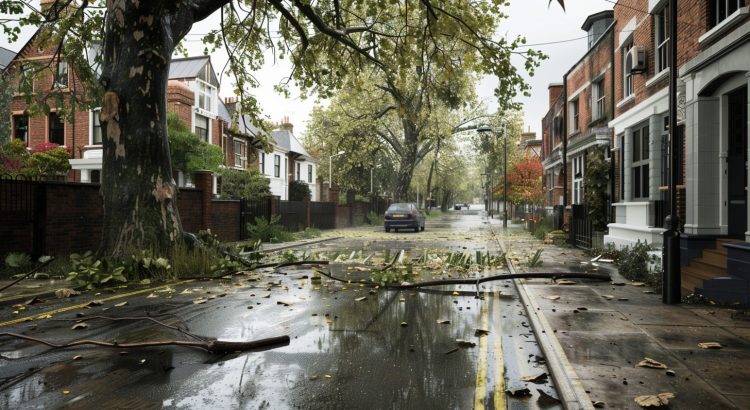
When a storm passes through Greater London, the visible aftermath – toppled fences, scattered debris, broken branches across pavements – tells only part of the story. The more significant question for qualified tree surgeons is not what has already fallen, but what is still standing and whether it is safe to remain so. Assessing structural failure risk in storm-damaged trees is a systematic, multi-stage process that draws on arboricultural science, specialist diagnostic equipment, and detailed knowledge of the urban conditions specific to the capital. It is not a task reducible to a visual scan from the pavement. A competent risk assessment integrates what can be seen with what can be measured and what can be inferred from the biology of the tree itself, producing a defensible, evidence-based judgement on whether a tree is safe to leave, requires remedial work, or presents an immediate hazard to persons or property.
Why Storm Damage Creates Hidden Structural Hazards
The Difference Between Visible Damage and Structural Compromise
The most dangerous post-storm failures are frequently invisible to the untrained eye. A tree may appear broadly intact – its crown full, its trunk upright, its bark unbroken – whilst having sustained significant internal damage during peak wind loading. Storm events generate enormous mechanical stress: branches are levered against their unions, trunks flex beyond their elastic limits, and root systems are subjected to sudden, repeated lateral force. The consequences do not always manifest immediately. Snapped anchor roots may have shifted without fully fracturing. Compressed wood fibres on the leeward side of the trunk may be structurally compromised yet visually indistinguishable from healthy timber. A co-dominant stem may have developed a crack at its union that will propagate under the next weather event. This is what arborists describe as residual risk – the failure potential that persists long after the storm has passed.
How London’s Urban Environment Amplifies Risk
Storm-damaged trees in Greater London carry a risk profile that is fundamentally different from those in rural settings. The capital’s urban forest grows under conditions that compound structural vulnerability at almost every level. Street trees and park specimens frequently occupy severely restricted root zones, their soil volumes limited by paving, kerb lines, and below-ground infrastructure. Decades of compaction – from foot traffic, vehicle loading, and construction activity – reduce drainage and limit the depth and spread of root anchorage. Many of London’s most prominent trees also carry the legacy of pollution stress, drought episodes, and historical pruning work that has altered their natural architecture. When a storm strikes a tree already operating at the margins of structural resilience, the consequences can be severe. The density of the built environment ensures that the potential target zone – the area at risk if the tree fails – is rarely unoccupied.
The Initial Visual Assessment – What a Tree Surgeon Looks For
Crown, Branch Structure, and Canopy Asymmetry
A qualified tree surgeon begins every post-storm assessment with a systematic visual survey, working methodically from the crown downwards. In the upper canopy, the focus is on identifying broken scaffold branches, suspended limbs – commonly known as widow-makers – and evidence of major structural loss. A single hanging branch retained in the crown by surrounding foliage can weigh several hundred kilogrammes and may fall with very little additional warning. Canopy asymmetry is a particularly significant indicator. A tree that has lost substantial mass on one side has had its centre of gravity altered, redistributing load onto the remaining root anchorage and changing the mechanical demands on the trunk. Where this asymmetry coincides with a pronounced or newly developed lean, the two factors must be assessed in combination rather than independently.
The Root Zone and Base – Signs of Failure at Ground Level
The base of the tree and the surrounding root zone frequently reveal the most critical information. Tree surgeons assess this area carefully for soil heave and cracking around the root plate – physical evidence that the root system has begun to lift under lateral loading. On the tension side of a leaning tree, exposed or snapped surface roots indicate that anchorage has already been partially lost. At the stem base, assessors look for basal cavities, wound tissue, and fungal fruiting bodies, which can signal advanced decay in the structural roots or lower trunk. Compression on the opposite side of the stem – displaced soil pushed down as the root plate pivots – is equally significant. Even slight ground movement in the immediate vicinity of a large tree is treated as a serious finding, warranting further investigation rather than a watch-and-wait approach.
Advanced Diagnostic Techniques Used by Professional Tree Surgeons
Resistograph and Sonic Tomography Testing
Where the visual assessment identifies potential internal defects, specialist instruments allow tree surgeons to quantify what cannot be seen from the surface. The resistograph drives a fine needle through the timber at a controlled rate, measuring resistance at each point along the drill path. Variations in resistance reveal the presence of cavities, decay columns, and changes in wood density, recorded graphically and interpreted against the structural cross-section of the tree. Sonic tomography maps internal defects by measuring how quickly sound waves travel between sensors placed around the trunk’s circumference. Decay and void spaces slow propagation; healthy, dense wood transmits sound rapidly. The resulting cross-sectional image allows the assessor to estimate the proportion of sound wood remaining. In a city where the removal of a mature specimen may be contested on conservation or amenity grounds, objective diagnostic data is essential to supporting a professional recommendation.
Pulling Tests and Root Anchorage Assessment
Static load testing – commonly referred to as a pulling test – is used where root anchorage integrity is in question. A controlled pulling force is applied to the trunk at a measured height, and the resulting movement at the stem base is recorded. The data provides a quantitative assessment of root plate stiffness and overall structural flexibility, which can be compared against established thresholds to determine how much additional load – saturated canopy weight, gusting wind – the tree can safely sustain. This technique is of particular relevance in Greater London, where root systems are routinely constrained by utilities, drainage infrastructure, and hardstanding. A tree whose anchorage zone is bisected by a service trench may yield very different pulling test results from a visually comparable specimen growing in open ground – a distinction that subjective assessment alone cannot reliably capture.
Risk Classification – How Tree Surgeons Categorise Storm-Damaged Trees
The THREATS Framework and Risk Matrices
Once assessment data has been gathered, the tree surgeon moves to formal risk classification. One widely used framework in British arboricultural practice is the THREATS mnemonic – Target, Hazard, Risk, Environment, Action, Time, Severity – which provides a structured methodology for converting observational and diagnostic findings into a defensible risk rating. The framework requires the assessor to consider not only the likelihood that a tree or part of a tree will fail, but also the probability that a failure will strike an occupied target zone and the severity of the likely consequence. Risk matrices combine these variables into a composite rating that determines the recommended course of action, ensuring that decisions are consistent, evidence-based, and proportionate to the actual hazard presented.
From Low Risk to Immediate Danger – What Each Category Means in Practice
In practical terms, the risk spectrum runs from trees placed on a routine monitoring schedule through to those requiring immediate intervention. A tree rated at the lower end may need nothing more than a follow-up inspection after the next significant weather event. Those in the middle range are typically candidates for remedial pruning, crown reduction, or cable bracing – interventions that reduce load, redistribute weight, or provide supplementary support to vulnerable unions. At the upper end, the assessment may conclude that a tree presents an immediate danger requiring emergency works. In Greater London, this finding carries particular weight. A high-risk tree overhanging a primary school in Islington represents an entirely different set of urgency and consequence factors from a comparable specimen in a low-footfall corner of a private estate in Richmond, and the risk classification framework is specifically designed to capture those distinctions.
The Role of Tree Preservation Orders and Local Authority Liaison in Post-Storm Work
Assessing structural failure risk is only one dimension of post-storm tree management in Greater London. A significant proportion of the capital’s mature trees are protected by Tree Preservation Orders (TPOs) or fall within designated Conservation Areas, meaning that even urgent remedial work is subject to regulatory oversight. Under ordinary circumstances, any works to a protected tree require prior written consent from the relevant London Borough. In practice, London’s 33 borough councils operate their own tree officer teams with differing procedures, response times, and thresholds for acceptable intervention.
Where a tree has been assessed as presenting an immediate risk to life or property, permitted development provisions under Section 206 of the Town and Country Planning Act 1990 allow emergency works to be carried out without prior consent – provided that the works go no further than necessary to address the immediate hazard, and that the local planning authority is notified as soon as reasonably practicable. Navigating this regulatory landscape requires familiarity with both the legal framework and the procedural expectations of individual boroughs. A tree surgeon operating across Greater London must be as confident managing that liaison as conducting the technical assessment itself.
Why Post-Storm Assessment Should Never Be Delayed
The interval between a storm event and secondary structural failure can be very short. Waterlogged soil in the weeks following heavy rainfall reduces frictional resistance around the root plate, increasing the likelihood of uprooting in trees that sustained partial anchorage damage during the original event. Decay in fractured or wounded wood progresses rapidly during the mild, wet conditions that typically follow autumn and winter storms across the capital.
There is also a significant legal dimension. Under the Occupiers’ Liability Acts of 1957 and 1984, landowners owe a duty of care to those who may be harmed by hazardous conditions on their land. Where a tree has been visibly storm-damaged and no formal assessment has been commissioned, the landowner’s exposure to liability in the event of a subsequent failure is considerably greater than where a risk assessment has been carried out, documented, and acted upon. For local authorities managing London’s public realm – including highways, parks, and housing estates – this duty is continuous, and the post-storm period represents one of the most legally sensitive phases of that ongoing responsibility.